There is an enormous crisis in the Catholic Church. Does it have to do with sexual abuse or something equally terrible? No, far worse. Pope Francis is being sneakily attacked by his predecessor. Obviously, the entire foundation of the Catholic Church is being rocked by this.
This, if more than a few Vatican watchers and commentators on social media are to be believed.
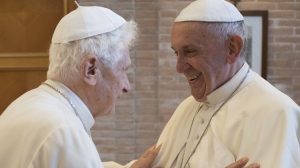 What happened? Today, the upcoming publication of a book was announced. A study of the priesthood amid the challenges of today, co-authored by Cardinal Robert Sarah and Pope emeritus Benedict XVI. Each contributing a chapter, both men underline the value of mandatory priestly celibacy and urge Pope Francis not to make it optional for priest in specific parts of the world. I won’t go into the theological reasoning here, as I don’t know enough about that to make a meaningful contribution. But that’s not the point of my blog post, really.
Much of the debate revolves around this fact, that the cardinal and pope emeritus have stated their thoughts about mandatory celibacy, and don’t think there should be exceptions. Critics of the book claim that that is contrary to what Pope Francis wants, and so this book must be an attack against him.
Upon his retirement, the pope emeritus said he wanted to spend the remainder of his life in prayer and solitude. Now that he has made a publication, his critics call him out for breaking his promise to remain hidden and quiet. But, the pope emeritus remains a private person with all his rights, and he is not bound by any law that should keep him quiet. He is free to state his thoughts, and this in itself should never be understood as an attack against anyone. To do so is dishonest and, to be fair, fantastical.
The problems that too many commentators have with the book, which is yet to be published, revolve around the idea that Pope Francis is open to relaxing the rules surrounding priestly celibacy. This contrary to his own statements that he is not. Rather, it was the (presumed) majority of synod fathers in the latest Synod of Bishops assembly on the Amazon, who pushed for the option that certain married men be ordained in areas where priests are largely absent. In his closing remarks, Pope Francis said nothing on the topic, and he is yet to issue any decisions on the matter
I found it striking that the vast majority of critical comments against the thoughts of Pope emeritus Benedict XVI and Cardinal Sarah seem to carry an undertone of imagined rivalry: good Pope Francis against sneaky Pope emeritus and cardinal. This despite the fact that the foreword to their book emphasis fidelity to Pope Francis, and nothing in past actions and publications presents any evidence to the contrary. Although to proponents of imagined rivalry it does.
In recent years an unhealthy development has taken place, strictly contrary to the synodality advocated by Pope Francis (whatever form that may ultimately take). Any real or imagined criticism against Pope Francis’ words, writings or actions must be automatically denounced and shut down, and the some goes for the persons doing the criticising. And often there is no criticism at all. Asking questions is not criticism, and neither is the deeper exploration of ideas and practices.
Pope Francis is the pope. He not only deserves our obedience, but we must also assume his good intentions. That’s normal. But that’s something different from frantically attacking anything that may possible be seen as an affront or critique. But that is what is happening. It does a disservice to both Pope Francis and to those who are forced into opposition against him by media and commentators who cling to a simplistic world view of good versus evil, conservative versus liberal. Pope Francis is neither, and nor is the pope emeritus or Cardinal Sarah. Reality is not black and white, and our faith and Church allows for different approaches, thoughts and ideas.
Agree or disagree with Pope Francis, or with the pope emeritus. Fine. But let’s do ourselves, our readers and the leaders of our Church the courtesy of taking them seriously.

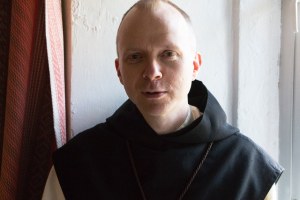 The new bishop of Trondheim is a Norwegian, but coming home by way of England, where he has been the abbot of the Mount Saint Bernard Abbey, a Trappist monastery in Leicestershire. Bishop-elect Erik Varden is, despite his role as abbot, young for a bishop. At 45, he is the fifteenth-youngest bishop in the world, and certainly the youngest in Scandinavia and Europe (if we exclude Ukraine, a country which can boast seven bishops aged 43 and younger). Additionaly, Fr. Varden has also not been a priest or a religious for very long. He entered the Order of the Cistercians of the Strict Observance in 2002, made his first profession in 2004, his solemn vows in 2007 and was ordained a priest in 2011. He has been the abbot of Mount St. Bernard since April of 2015.
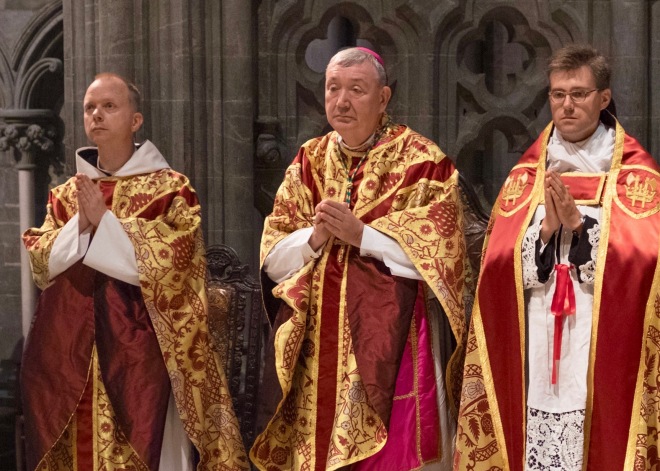 ^Bishop-elect Erik Varden, left, with Bishop Bernt Eidsvig of Oslo, during the former’s previous visit to Trondheim in 2018, when he gave the annual Olsok lecture.
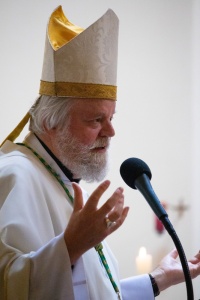 On the occasion of the 40th anniversary of Bishop Jan Hendriks’ ordination to the priesthood, celebrated last Friday at the diocesan shrine of Our Lady of Need in Heiloo, Bishop Jos Punt announced his intention to ask the pope for an early retirement next year.
 The Holy See today released the full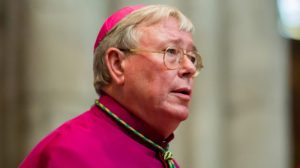
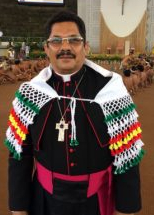 Also of note is the role of Bishop Karel Choennie of Paramaribo (at right). As his diocese, which covers all of Suriname, is included in the pan-Amazon region, he is an automatic participant, but he has also served on the Presynodal Council, which was tasked with the preparations for the upcoming assembly. Another member of this body is Bishop Erwin Kräutler, the Austrian-born bishop-prelate emeritus of Xingu in Brazil. The 80-year-old prelate presents himself as a close confidant of Pope Francis, but he also supports a number of problematic changes to Catholic teaching and practice.
 This made me wonder: how do the bishops of the Dutch language area compare? Not that favourably, actually. Of the 18 bishops in the Netherlands and Flanders (I haven’t counted the emeriti), only five have any social media presence. Those five all use Facebook, one also uses Twitter and a third one adds Instagram. Their reach is also much smaller than that of their German speaking brethren, but that is easily explained by the size of the Dutch language area.
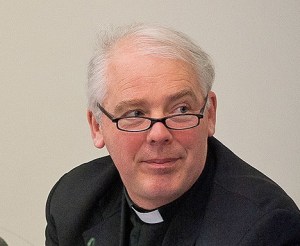 Topping the list is Bishop Everard de Jong (pictured), the auxiliary bishop of Roermond. He has 5,000 friends on
 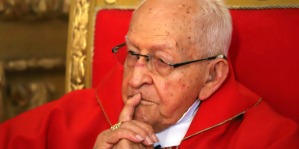 Tuesday saw the passing of Cardinal José de Jesús Pimiento Rodríguez. The 100-year-old Colombian prelate was the emeritus archbishop of Manizales and was made a cardinal by Pope Francis in 2015. In
 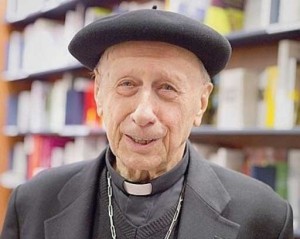 Upon Cardinal Pimiento’s death, the title of oldest cardinal fell to Cardinal Roger Etchegaray, only for him to pass on that title the next day. The 96-year-old French cardinal-bishop served as archbishop of Marseille before taking on duties in Rome, heading the Pontifical Councils for Justice and Peace and “Cor Unum”. Even after retiring he was an active advocate for peace in the world, as recalled by Pope Francis in
 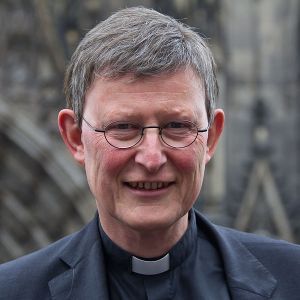 “I was surprised by how closely my conversation partners are following the situation of the Church in Europe and especially in Germany. Everywhere I was struck with the concern about current developments in Germany. A noticeable concern in many encounters was that the “synodal path” is taking us on a specifically German path, that, at worst, we are putting the communion with the universal Church at risk and are so becoming a German national church. That is not something that anyone should want, and we should take that warning very seriously. Many of my conversation partners expressed their disbelief that in Germany we appear to be willing to change the deposit of faith entrusted to us, just because this is loudly demanded of us. The fear that this could lead to a split in the universal Church, or even a split in the German Church, was openly expressed. Of course the dioceses in America are also not immune to the questions which concern us. But I am under the impression that there they are providing answers based on the faith of the universal Church, and not in the form of independent national action or some form of theological overconfidence.”
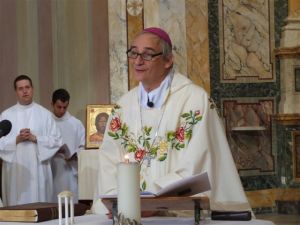 (pictured at left giving a homily at the Church of the Frisians in Rome in 2015)
 Bishop Gerard de Korte of ‘s-Hertogenbosch travelled New England, including New York and Washington DC, with his sister, and wrote
 In Caelo et in Terra